Horse! No? More than 7,000 wild horses were killed in Australia, while 68 disappeared in the US, in the Year of the Horse
What? Horse? More than 7,000 wild horses were killed… In Australia, while 68 disappeared in the US, in the Year of the Horse
AUTHOR: Ruslana PETROVA
How did the number of wild horses killed in Australia exceed 7,000 while the country
continues culling them from helicopters? And how were 68 protected American mustangs
sold for 22 euros each, loaded in the middle of the night and lost from the sight of the authorities?
Since February 17, 2026, the world has symbolically been living in the Year of the Fire Horse. A sign associated with freedom, strength and movement. It was precisely during this year that the number of wild horses killed in Australia’s Kosciuszko National Park exceeded 7,000, while in the US, 68 mustangs lost state protection for 25 dollars each and disappeared after being loaded at night.
For What? Horse?, this is the year’s biggest horse tragedy. Behind it lies not a single random act of cruelty, but laws, government programs, budget decisions and administrative terms such as “removal,” “control” and “sale.”
More than 7,000 wild horses killed in Australia
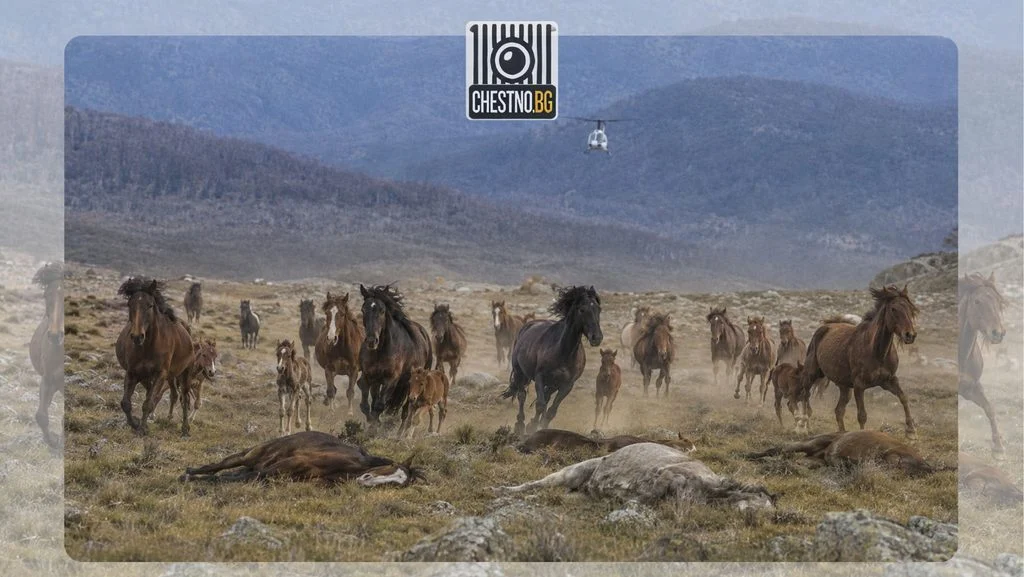
More than 7,000 wild horses, known in Australia as brumbies, have been killed in Kosciuszko National Park since late 2023, Australia’s Daily Telegraphreported in August 2026. The main method is shooting from helicopters.
Earlier SBS data showed more than 6,000 horses shot from the air. An official parliamentary response recorded 6,817 animals “removed” by June 11, 2026, but this category also includes capture, relocation and adoption. The figures do not directly contradict each other, as they cover different periods and different methods.
The New South Wales government is required to reduce the park’s population to 3,000 horses by June 30, 2027. The plan provides for that number of animals to be preserved in designated areas, while in the remaining 68% of the territory their presence is to be gradually reduced to zero. The official New South Wales plan allows aerial shooting alongside capture, relocation and shooting from the ground.
A national symbol to some, a pest to others
Brumbies are descendants of domestic horses brought to Australia after European settlement. They feature in the legends, literature and history of mountain communities, but authorities classify them as invasive animals.
According to ecological assessments, the herds trample sensitive alpine vegetation, compact and erode the soil, degrade the condition of streams and wetlands, and affect the habitats of more than 30 protected species and natural communities.
The latest count, conducted in autumn 2025, produced a wide range of between 6,476 and 16,411 horses, with the most likely single estimate being 10,309. The method has been peer-reviewed, but brumby advocates dispute the results and point to the huge difference between the lower and upper limits. ABC Australia has confirmed both the figures and the resumption of aerial shooting in June 2026.
A total of 11,002 submissions were received during the public consultation on the program. Of those who commented specifically on helicopter shooting, 82% supported it. Australia is divided between the cultural image of the free horse and the fear that this same horse is destroying a fragile ecosystem.
They kill the horses from helicopters…
An independent veterinary assessment shows how the operation is carried out. Over two days in November 2023, veterinarians observed the pursuit of 277 horses. Of these, 270 were killed, while seven managed to escape without being shot.
The helicopter initially pressures the herd from a greater altitude and directs it toward terrain suitable for shooting. It then descends low and moves directly behind the fleeing animals. The average duration of aerial pressure and pursuit is 84 seconds, while the longest documented case lasts 7 minutes and 16 seconds.
A total of 2,032 shots were fired at the horses, an average of 7.5 for each animal killed. The veterinarians determined the average time to loss of consciousness to be five seconds and found no horses that had been shot but remained alive. Among those killed were 35 young horses and recently born foals, as well as two very small foals. The data were published in the official independent animal welfare assessment.
Authorities use these results as evidence that death occurs quickly. Opponents of the operation emphasize the fear, flight, breakup of the herds and the number of shots needed to kill each animal.
Most of the carcasses remain in the national park…
After the shooting ends, most of the carcasses are not removed. They are left to decompose where they lie, as is also done with killed feral pigs and deer.
The rules stipulate that carcasses must not be left in major waterways or within 400 meters of busy campsites and tourist sites, where the terrain allows this. Government monitoring claims that the environmental consequences are highly localized and largely disappear within a year.
The other proposed solution, relocation to private homes, does not reach the necessary scale. In 2022-2023, places were found for 513 horses. According to the authorities, there are not enough prepared applicants willing to take in thousands of animals of all ages, in varying states of health, that are not accustomed to human contact.
68 mustangs sold for 22 euros each
On the other side of the world, the state does not shoot the horses. It captures them with helicopters, keeps them behind fences for years and eventually sells them.
A group of 68 American mustangs lived freely in the desert mountains of the West before being rounded up in a federal operation. The horses were taken to a holding facility in Idaho, where they remained for years while the Bureau of Land Management, BLM, sought suitable owners for them.
In March 2026, they were all sold to Ohio livestock dealer Brandon Jones. The price was 25 dollars, or about 22 euros, per horse. The entire herd changed hands for less than 1,500 euros.
The mustangs were loaded into metal trailers and transported approximately 2,900 kilometers to Ohio. Just one day after their arrival, at midnight, two double-decker livestock trucks came to the property. The horses were loaded and driven away. They did not appear at a public auction, and Jones refused to say where they had been sent.
He denies selling them for slaughter. Wild horse advocates suspect that the animals were shipped to Canadian slaughterhouses, but the fate of these particular 68 mustangs has not been established. The last confirmed fact is their nighttime departure from Ohio.
The law protects mustangs only until they are sold
The 1971 Wild Free-Roaming Horses and Burros Act defines them as living symbols of the historic and pioneering spirit of the West. On federal lands, they are protected from unauthorized capture and killing.
However, a 2004 amendment requires the BLM to sell “without limitation” animals over 10 years old or those that have not been selected for adoption at least three times. Upon sale, ownership is transferred immediately and the horse ceases to be a protected wild animal under the law.
The BLM says it does not sell mustangs to slaughterhouses and does not allow buyers to transfer them for processing into commercial products. In 2026, the agency tightened buyer declarations and introduced a standard starting price of around 108 euros, while allowing lower prices in special circumstances.
On the same official page, however, the BLM acknowledges the significant gap: sold animals become private property, and the agency does not track them after the transaction is completed. An investigation begins only if information later emerges that a specific horse has ended up at a slaughterhouse or a so-called kill pen. The program’s conditions are published by the BLM itself.
The state loses thousands of euros, while an intermediary may profit
According to an investigation by The New York Times capturing and preparing a single mustang for sale can cost the state more than 2,500 euros. The same animal has been sold for around 22 euros, while its ultimate value to a slaughterhouse may reach approximately 645 euros.
Since 2025, around 500 horses from the program have been sent to Brandon Jones. Four were later found at an auction in Tennessee attended by slaughterhouse brokers. After another sale of 97 mares, two trucks carrying mustangs crossed into Canada, and the BLM’s federal brands were identified on the horses. Jones denies having been involved in sending them to slaughter.
The investigation, including the story of the 68 horses, was published by The New York Times and republished by GV Wire on August 22, 2026.
Thousands of mustangs leave the wild every year
The scale of the issue is not limited to a single trader. In fiscal 2025, the BLM sold 2,387 horses and 1,331 wild donkeys, a total of 3,718 animals. The year before, the total was 1,509.
At the same time, 58,025 horses and donkeys are being kept in government holding facilities and pastures outside their natural range. Their upkeep consumes most of the program’s budget. In fiscal 2025 alone, another 7,853 animals were removed from the wild. The figures come from the BLM’s official statistics.
This creates an administrative cycle: the horses are captured, the holding facilities fill up, costs rise, and low-priced sales free up space. Once the document is signed, the government knows the buyer’s name and the price paid, but stops tracking the animal.
Bulgarian horse herds have taken a different path
Bulgaria has no directly comparable population of tens of thousands of horses legally classified as wild, nor data on a government aerial shooting program like Australia’s. But free-grazing and semi-wild horse herds live in our mountains, raising the same practical question: can the horse remain part of the landscape without being left without care and oversight?
In the Eastern Rhodopes, Karakachan horses and Konik ponies are used in projects to restore natural grazing. According to data published by Rewilding Europe for 2020, around 120 Karakachan horses and nearly 100 Konik ponies were roaming freely in the area.
The Karakachan horse is an old local breed adapted to year-round life outdoors and sparse mountain forage. Konik ponies were introduced to the Eastern Rhodopes in 2011 as part of a program to restore natural processes. Through grazing, the animals limit overgrowth, maintain open spaces, and create more diverse habitats. The Eastern Rhodopes project regards horses as part of nature management, rather than as surplus to be removed.
These herds belong to no one. They have owners or managing organizations, are subject to identification and veterinary control, and move freely within a defined system. The Bulgarian example cannot mechanically solve a problem on the scale of Australia or the American West, but it proves that the word “free” is not necessarily synonymous with “abandoned.”
Comments