The Shadow Beside the Bed: People Around the World See the Same Nocturnal Visitor…
The Shadow by the Bed: People Around the World See the Same Nighttime Visitor…
AUTHOR: Ruslana PETROVA
She is a mara, a jinn, an old witch, a demon or a faceless figure in the darkness. Why do people
separated by centuries and oceans, describe the same terrifying encounter: an awake mind,
an immobile body and someone's presence beside the bed? And how does science explain
an experience that continues to sound like a supernatural warning?
You wake up in the middle of the night and immediately realize that something is wrong. You see the room, hear the silence, perhaps make out the light under the door, but your body will not move. You try to cry out, but no sound comes from your throat. Then comes the most frightening part: the feeling that someone else is in the room.
Sometimes it is a shadow by the bed. Sometimes a figure stands in the doorway. At other times, an invisible weight presses on the chest and every breath seems to have been stolen. After seconds or minutes, the grip disappears. The room is once again just a room, the door is closed, and the nighttime visitor has left no trace.
And yet the story has been repeated for centuries, with details so similar that humanity has given dozens of names to what comes between sleep and wakefulness.
One Visitor, Dozens of Names
In Ancient Greece, it was called Ephialtes , a creature that leaps onto a sleeping person. Medieval Europe saw it as an incubus or succubus, a demon that comes at night and presses down on its victim. In northern legends, the maraappears, while in some Slavic traditions it is the closely related mora. Old English mare has also left its mark on the modern word nightmare.
Japan knows kanashibari , a condition whose name conveys the feeling of being “bound as if with metal chains”. In Newfoundland, the culprit is the Old Hag, who sits on the chest. In Egypt, some people who have experienced sleep paralysis associate it with jinn, while in Cambodia people tell of the “ghost that presses you down”.
One of the most vivid versions lives on in Brazil. There, the nighttime intruder is Pisadeira , a thin old woman with long fingernails who lurks on rooftops and steps onto the chest of someone who has fallen asleep on their back after a heavy meal.
In contemporary accounts, the ancient demon sometimes changes its costume: it becomes an alien, a hooded person or a faceless black figure.
The faces are different. The scene barely changes: a bedroom, immobility, pressure, fear and the insistent certainty that someone has come.
A Doctor Describes the “Demon” as Early as 1664
One of the earliest medical descriptions was published in 1664 by the Dutch physician Isbrand van Diemerbroeck. His patient described feeling a devil on top of her at night, unable to speak or move and barely able to breathe under the terrible weight.
The doctor titled the case “On the Incubus, or Nightmare” , the language of medicine still had one foot in folklore.
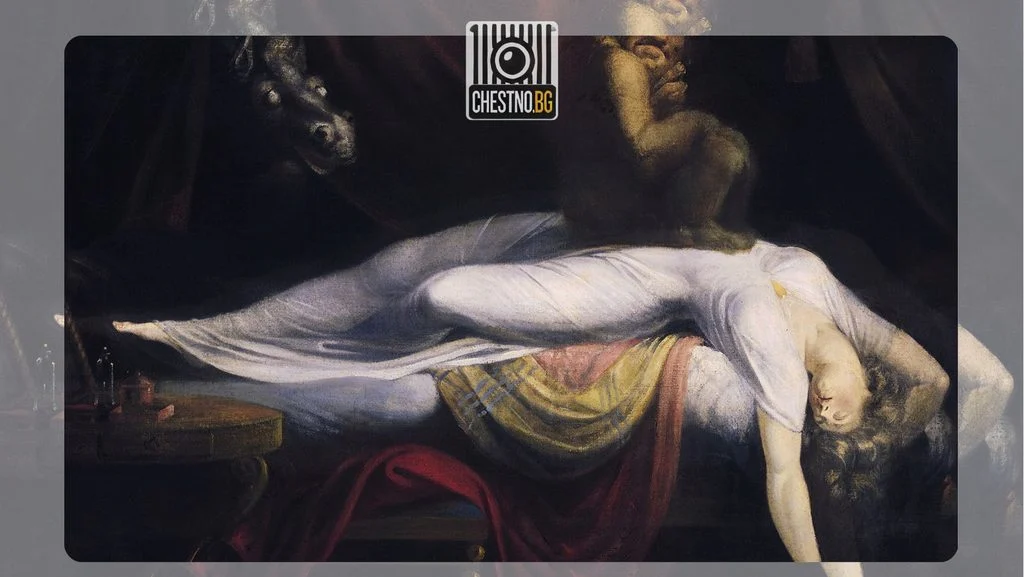
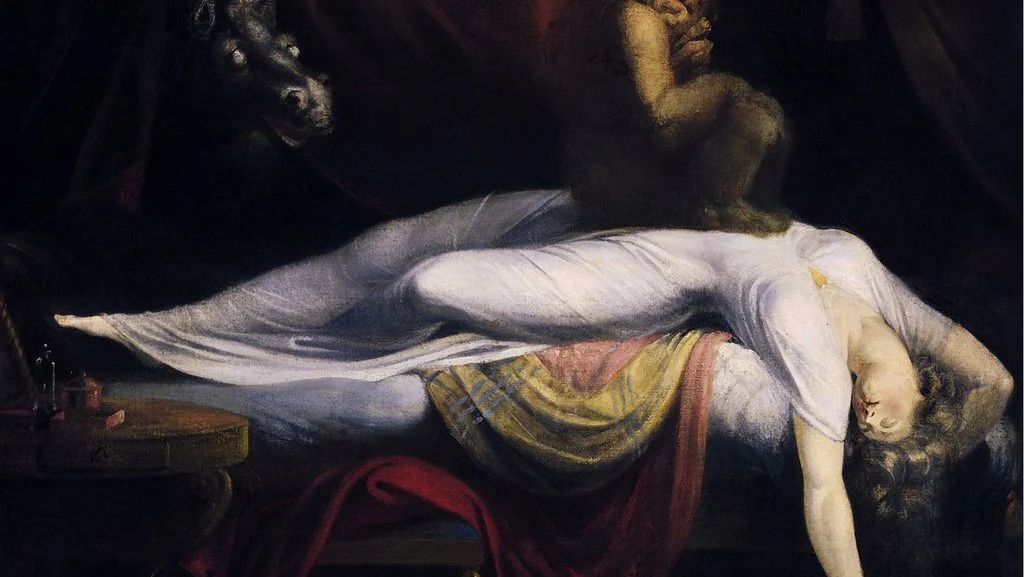
More than a century later, the painting “The Nightmare” by Henry Fuseli, from 1781, captures the same image: a woman lies helpless, a demonic creature sits on her chest, and a horse’s head peers out of the darkness. The work is often regarded as one of the most recognizable artistic depictions of sleep paralysis.
The medical term itself, sleep paralysis did not emerge until 1928.
The monster, however, is older than the diagnosis. Hippocrates mentioned nighttime suffocating experiences as early as around the fourth century BC, while the human imagination turned them into demons long before science looked into the sleeping brain.
The Brain Wakes Up, the Body Remains Asleep
Today’s explanation is less supernatural, but almost as strange.
During REM sleep, the phase in which dreams are usually most vivid, the brainstem temporarily suppresses much of the musculature. This protective “lock,” linked to signals from the neurotransmitters GABA and glycine, prevents us from acting out our dreams with our bodies.
In sleep paralysis, consciousness returns before the muscle blockade has ended. The person is awake enough to recognize the room, but is still trapped by the bodily rules of REM sleep.
The eyes may be open and breathing continues, but the sensation of restricted movement in the chest can easily turn into panic and a fear of suffocation. The episode is usually brief, although to the person experiencing it, time may seem stretched into eternity.
This intermediate state explains the immobility. The more disturbing mystery remains: why does someone else appear so often?
Why does “someone is in the room” feel like an absolute truth?
Researchers group experiences of sleep paralysis into three recurring patterns.
The first is “the Intruder” : intense fear, a sense of presence, footsteps, whispers or a figure in the darkness. The second is “the Incubus” : pressure on the chest, pain and the feeling that someone is sitting on the body. The third involves unusual bodily sensations: being carried through the air, falling, spinning or leaving one’s own body.
Here, sleep has not ended completely. Images, sounds and bodily sensations from it can be superimposed on the real bedroom. The result is an especially convincing mixture: the familiar room is real, the fear is real, the inability to move is real, so the figure by the bed is also perceived as part of that same reality.
One scientific hypothesis draws attention to the temporoparietal region, which is involved in constructing our sense of where our own body is located.
When the brain sends a command to move but the paralyzed body does not return the expected response, this internal map may become disrupted. The shadow could then be a mistaken projection of the sleeper themselves, their immobile “double self,” perceived as an alien presence.
This is an intriguing model, not a conclusively proven cause of every nighttime figure.
Folklore Does Not Invent Fear, It Gives It a Face
The scientific explanation does not mean that people are lying or consciously imagining things. The experience is real as a perception and can be devastatingly convincing. Culture provides the image with which the mind fills the darkness.
For a person in the Middle Ages, pressure on the chest naturally took the form of a demon. For a Japanese person raised on stories of kanashibari, the invisible chains already had a name. In Brazil, Pisadeira steps onto the bed. In the age of UFOs, the same condition may be described as an alien abduction.
Thus, a biological feature becomes a cultural mirror. The brain supplies the immobility, the pressure and the presence; time and place choose the mask.
There is no scientific evidence of an external visitor, but there is compelling evidence that expectations and beliefs influence how the experience is recognized, remembered and recounted.
How Many People Have Encountered the Shadow?
A systematic review of 35 studies involving more than 36,000 participants found that around 7.6% of people in the general population had experienced at least one episode of sleep paralysis.
Among students, the proportion in the included studies reached 28,3%, 31,9%. The figures vary depending on the group studied and the definition used, so they should not be taken as a universal frequency for every society.
For many people, the event remains a one-time occurrence. It is reported more often with sleep deprivation, disrupted schedules, stress and sleeping on one’s back; it may also occur alongside disorders such as narcolepsy.
A single episode is usually brief and, in itself, does not mean that a person is ill. In the event of frequent or highly distressing experiences, marked daytime sleepiness or sudden loss of muscle tone, consulting a doctor or sleep medicine specialist is advisable.
If the shadow comes tonight…
The most disturbing detail is not that different cultures have invented monsters. It lies in the remarkably similar posture they have given to fear: something stands beside the bed or presses on the chest precisely at the threshold between two worlds, sleep and wakefulness.
Science explains the door. Folklore has preserved the memory of what it feels like to remain locked behind it.
If you open your eyes tonight and there is a shadow in the corner, try to remember one thing: the mind is already awake, but the muscles are still returning from REM sleep.
The nighttime visitor almost always disappears the moment the body remembers how to move, without opening a single door.
SOURCES
- Prevalence: Sleep Medicine Reviews, 2011
- Cultural images and the three models: Frontiers in Psychology, 2016
- The historical case from 1664: JRSM Open, 2015
- REM sleep and the intruder hypothesis: Frontiers in Human Neuroscience, 2017
- Risk factors: Sleep Medicine Reviews, 2018 Muscle atonia during REM sleep: NINDS, updated in 2025
Comments