Skeleton found in a huge jar near Burgas
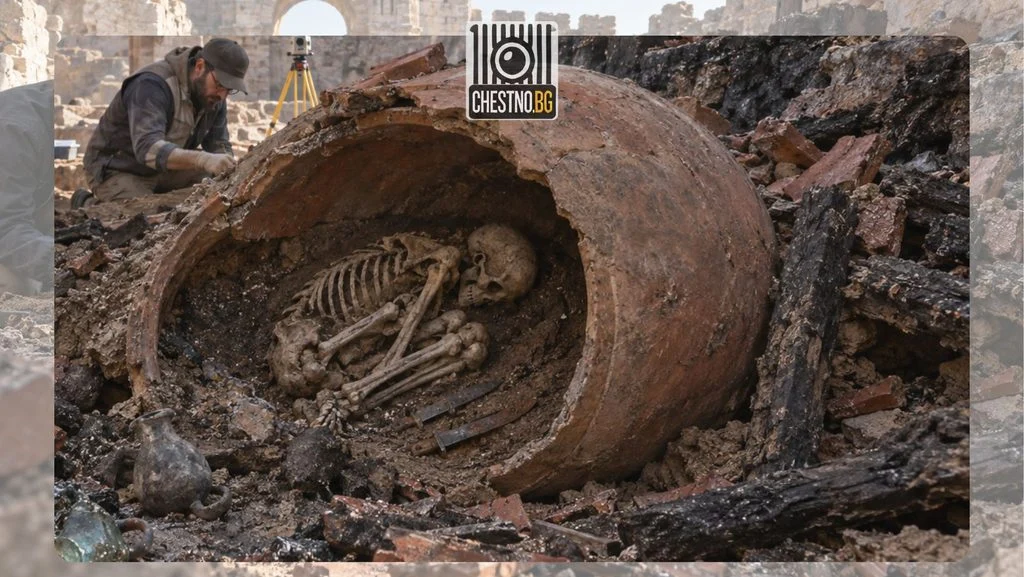
Skeleton discovered in huge storage jar near Burgas
AUTHOR: Ruslana PETROVA
Как човек се озовава свит в огромен керамичен съд преди около 1600 години?
Опитвал ли се е да се скрие, докато наоколо вече е горяло? Находка от Деултум
край Дебелт събира на едно място човешки останки, следи от пожар и въпроси, на
които археологията тепърва ще отговаря.
Archaeologists sometimes discover objects, sometimes buildings, and sometimes entire layers of history. More rarely, they come across a scene that looks like a frozen moment from someone’s final attempt to survive.
That is exactly the kind of find made at Deultum, near the village of Debelt, not far from Burgas. During excavations of a newly discovered late antique gate tower, archaeologists found a human skeleton curled up inside a large ceramic storage vessel. The working hypothesis is that the person sought shelter in the vessel during an attack or fire but was unable to get out.
The discovery was made on August 10, 2026, and according to the excavation director, Prof. Dr. Lyudmil Vagalinski, it offers an unusually direct glimpse into dramatic events in late antiquity.
Where exactly was the skeleton found at Deultum?
The find was made in a late antique gate tower near the western gate of the ancient city of Deultum. An archaeological team led by Prof. Lyudmil Vagalinski of the National Archaeological Institute with Museum at the Bulgarian Academy of Sciences is currently working there.
The skeleton was found in a large ceramic vessel described as a pithos or dolium. Vessels of this type were used in antiquity to store food and liquids. In this case, the vessel was empty and large enough for a person to fit inside.
The position of the body is among the most striking details of the entire find. Preliminary observations indicate that the person was curled up with their knees pressed against their chin, face down, as if seeking the smallest possible space in which to hide.
Why do archaeologists believe the person was hiding?
At present, there is no inscription, document or other direct source explaining exactly how the person died. There is, however, an archaeological context that points to a likely scenario.
Traces of a major fire and destruction were found around the vessel: ash, charcoal, collapsed bricks and roof tiles, charred walls, melted glass and burned animal bones. Two iron knives and a belt were also found near the skeleton.
This combination leads the team to believe that the person entered the vessel during an emergency, probably an attack, when a fire was already burning in the area or there was an immediate danger. According to Prof. Vagalinski, the ash beneath the skeleton suggests that the person may have entered the vessel after the fire had already started.
This is the important distinction between fact and hypothesis. The fact is that human remains were found in a large vessel, along with clear signs of destruction. The hypothesis is that the person was hiding from attackers or seeking refuge from the fire.
The objects found
The two knives and the belt also provide clues, although not a definitive answer. For now, they indicate that the person did not end up in the vessel by accident after the destruction, but was inside it with personal belongings.
This does not automatically mean that the person was a soldier. According to the archaeologists’ preliminary comments, the individual was not necessarily an armed combatant. The knives may have been part of the equipment people carried in everyday life, rather than military gear.
Bronze coins were also found in the layer of destruction around the find. According to the archaeologists, they were probably lost in the turmoil. This detail alone does not prove that an attack took place, but it reinforces the picture of everyday life abruptly brought to an end.
When did the tragedy occur?
The preliminary assessment dates the event to around AD 400. This is a working date that may be refined further after all field data from the excavations have been processed.
This is precisely where the greatest caution is needed with sensational explanations. Deultum experienced repeated crises and attacks during late antiquity. Historically, the area was affected by invasions by various groups, including East Germanic tribes and the Huns. But archaeologists are not currently claiming that they know exactly which attack was behind this person’s death.
This cannot be proven for now.
Why the find is so striking
Archaeology usually works with clues that have to be assembled like a puzzle. Here, the puzzle is unusually clear on a human level.
This is not just a skeleton, but a posture, a place and an environment that create an almost immediate scene. The person is inside a vessel large enough to have been used as a hiding place. There are traces of fire and a collapsed structure around them. Personal belongings are with them. The person does not appear to have been placed there as part of a burial ritual.
This makes the find different from a standard burial. It appears instead to be a death that occurred at a moment of sudden danger.
Another striking detail is that, according to the archaeologists, the skeleton shows no obvious signs of a last-minute attempt to escape from the vessel. This could mean various things: suffocation, a blow, fire, a collapse or a rapid loss of consciousness. But without anthropological analysis, all of this remains speculation.
The remains have already been sent to Sofia for anthropological examination
This should help determine more precisely the person’s sex, age, physical characteristics and any possible injuries.
If the bones bear signs of violence, fire or specific damage, this could narrow down the range of possible explanations. If no such traces are found, that will also be an important result, as it will rule out some of the hypotheses.
At the same time, archaeologists are continuing to study the western gate and the adjacent fortification structures of Deultum. The expectation is that the broader context of the excavations will help determine whether this was an isolated incident, destruction caused by an attack or a larger episode in the life of the late antique city.
Deultum once again brings an individual story out of the grand narrative of history
Large historical narratives usually speak of empires, invasions, fortifications and destroyed cities. This find narrows the entire picture down to one person, one vessel and one moment of fear.
For now, archaeology cannot say what the person’s name was. Nor can it say with certainty whom the person saw, exactly what they were fleeing from or whether they realized they would not get out of the vessel.
It can, however, say something powerful enough: at Deultum near Debelt, a person caught in an emergency situation around 1,600 years ago has been discovered, and the place where they were found makes this one of the most unusual archaeological finds in Bulgaria this year.
Comments